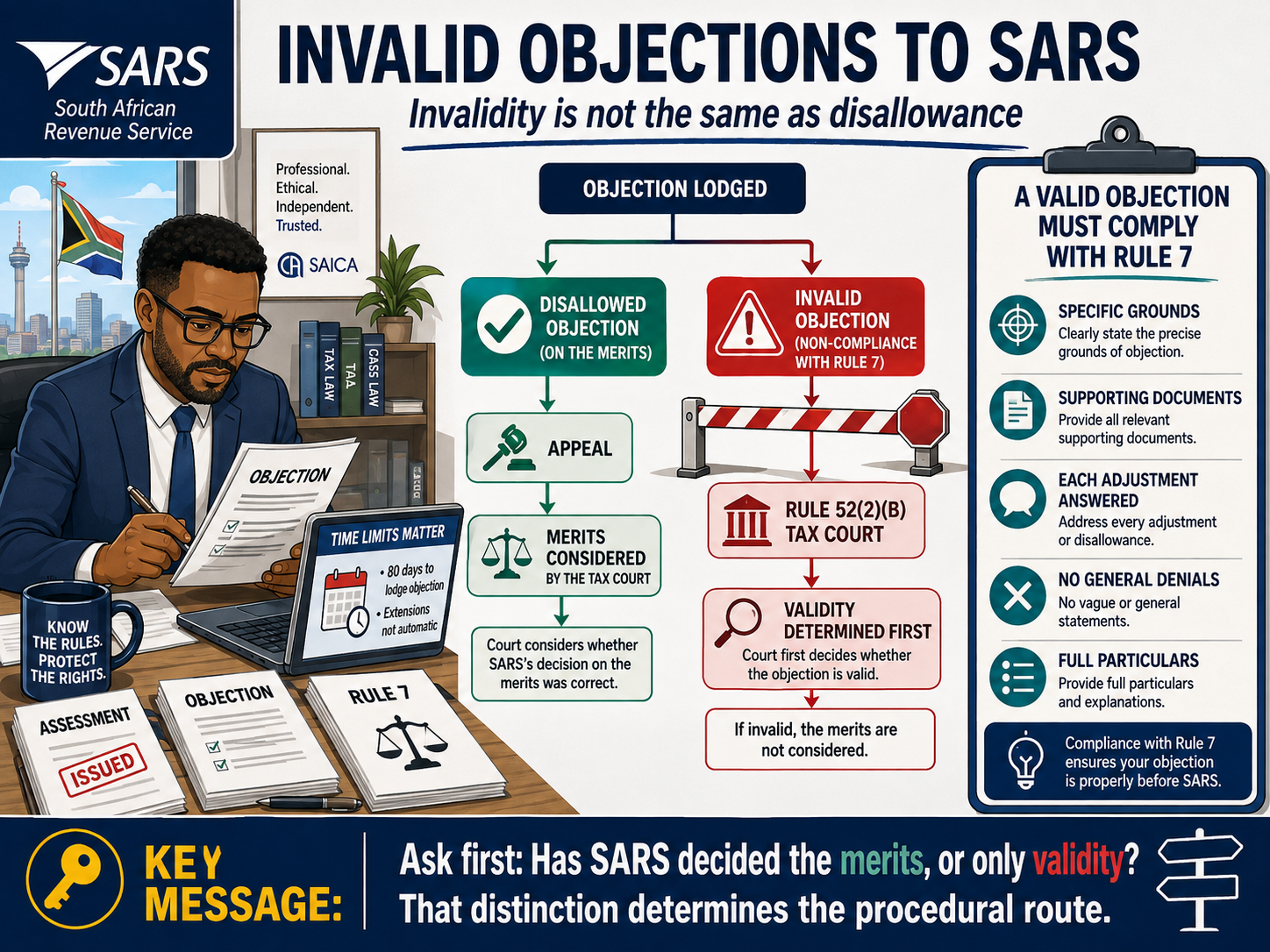
Accfin Sky
Resources

Tax Knowledge Centre

Curated articles, insights and visual guides on South African tax — written by Mark Silberman a member of the SAICA Tax Technology Committee.

SARS section 95(1)(c) estimated assessments: when verification goes too far

When SARS verification letters become excessive, vague or punitive — and how taxpayers can respond before an estimated assessment is raised.

Introduction

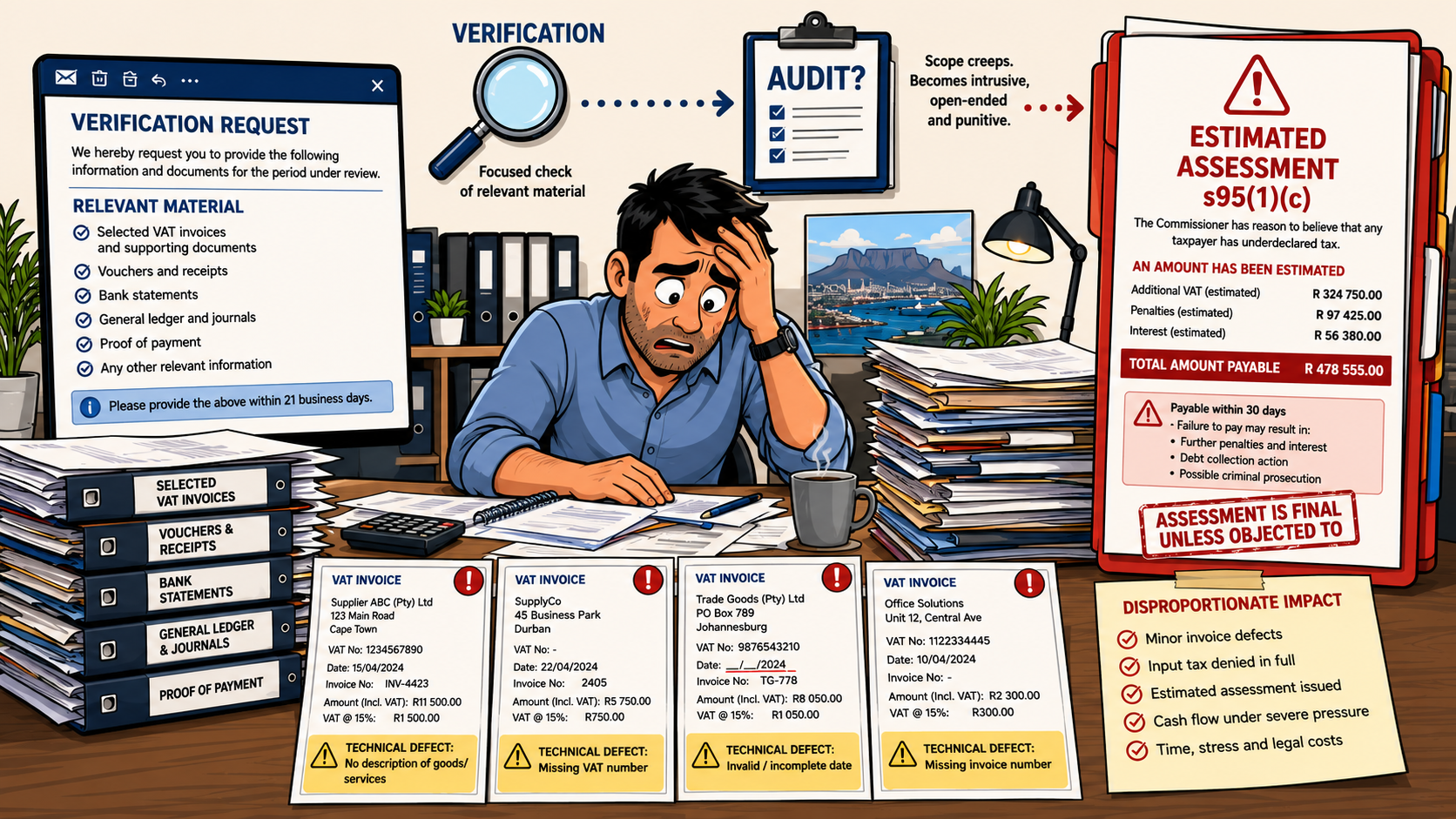
SARS is increasingly issuing verification letters requesting "relevant material" and warning taxpayers that, if the material is not submitted, SARS may raise an estimated assessment under section 95(1)(c) of the Tax Administration Act.

This warning is serious. In VAT matters, SARS may reverse input tax. In income tax matters, SARS may disallow deductions or estimate taxable income. The result can be a substantial assessment, even where the underlying transaction is genuine and the taxpayer can ultimately prove the claim.

The issue is not whether SARS may request documents. SARS clearly has that power. The issue is whether SARS may rely on section 95(1)(c) where the request is vague, excessive, impractical, not properly received, or where SARS treats a minor defect as a basis for reversing the claim.

In my view, this is where the process may become procedurally unfair and, in appropriate cases, unlawful.

What section 95(1)(c) does

Section 95(1)(c) permits SARS to raise an assessment based on an estimate where the taxpayer does not respond to a request for relevant material under section 46 after more than one request has been delivered.

This power must be used carefully. Section 95(1)(c) is not a penalty provision. It is an estimating mechanism. SARS may use it where it cannot finalise the assessment because the taxpayer has failed to provide material that SARS properly required.

That does not mean SARS can make any request, however wide, and then raise an estimated assessment if the taxpayer does not comply perfectly. SARS must still act lawfully, reasonably and procedurally fairly. The estimate must also be rational and based on information available to SARS.

The purpose of relevant material in a verification

The key phrase is "relevant material". In a verification, SARS should be checking a specific item, claim, amount or risk in the return. Relevant material is material that helps SARS verify that specific issue.

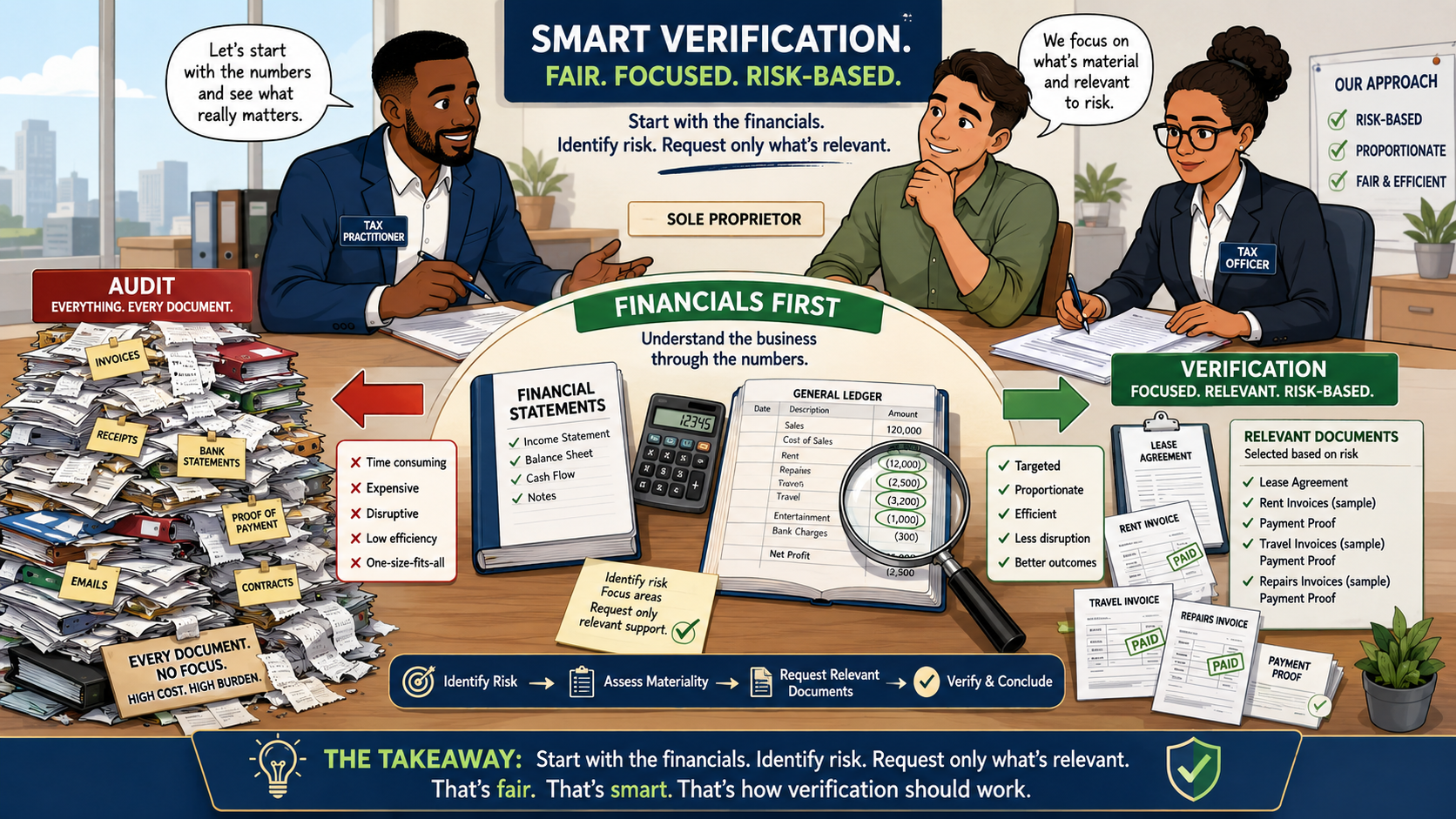
A verification is not supposed to be an open-ended inspection of the taxpayer's entire accounting system. If SARS wants to verify VAT inputs, it may ask for selected invoices and proof of payment. If SARS wants to verify expenses, it should identify the expense category or claim. If SARS wants to verify turnover, it should identify the information needed to test turnover.

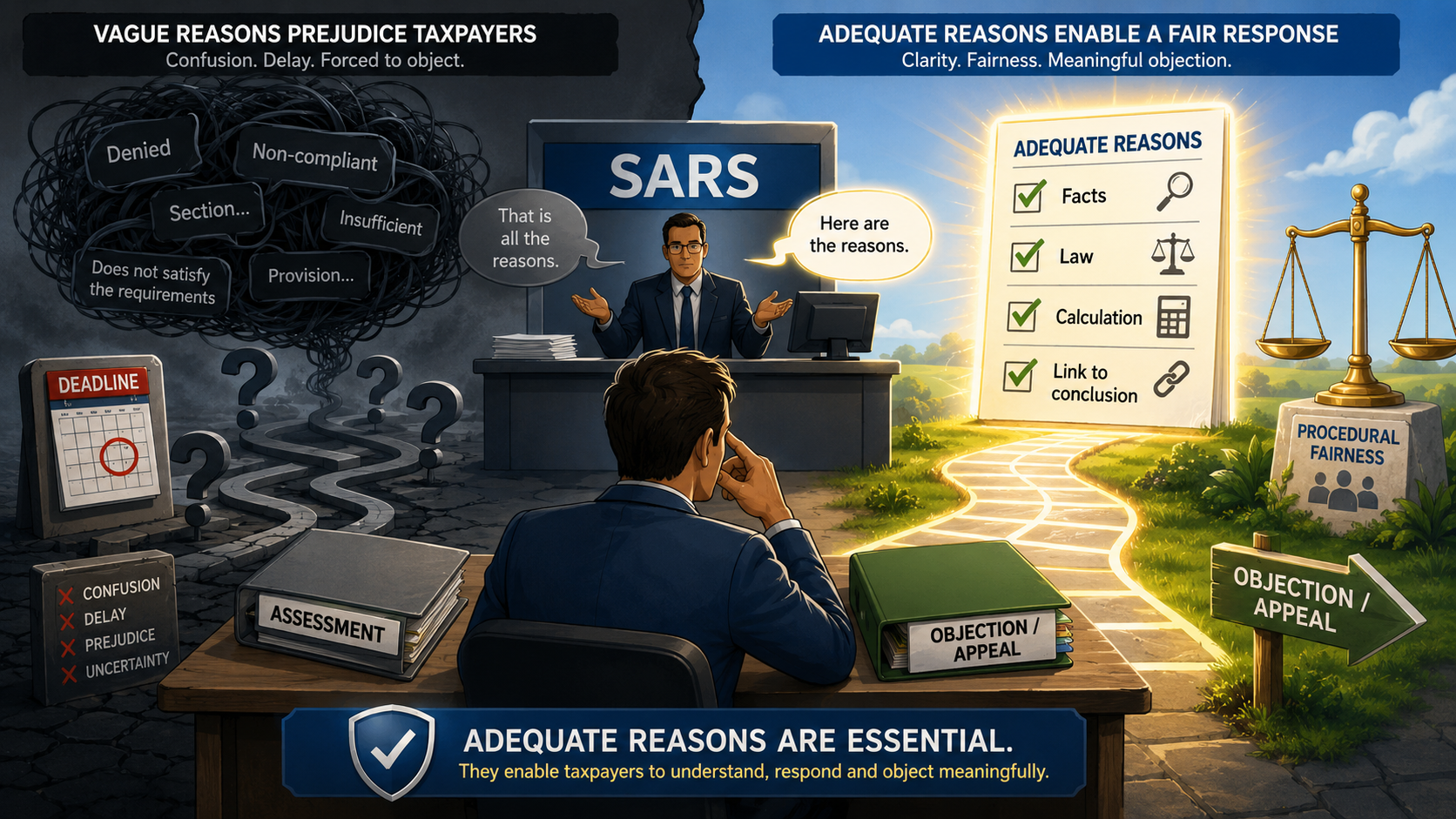
A proper request should therefore identify: what SARS is verifying; which documents are required; why those documents are relevant; how they must be submitted; and a reasonable time for compliance. If the taxpayer is left guessing what SARS wants, the request is defective.

VAT, sole proprietors and professional practices

The practical problem differs depending on the tax type and the taxpayer.

In VAT verifications, SARS does not necessarily request all input tax invoices. It often asks for a selection of the larger or higher-risk input invoices, together with proof of payment and supporting documents. That can be a legitimate verification process if the request is targeted and proportionate.

The problem arises where SARS reverses input tax mechanically because a selected invoice was not uploaded in time, was only partially provided, or contains a minor or curable defect. A vendor may have made a genuine taxable supply, paid the supplier, and hold records proving the transaction. In those circumstances, SARS should not treat a late upload, partial response or technical invoice defect as automatic proof that the input tax does not exist.

SARS should identify the defect, explain why it is material, and allow the taxpayer a fair opportunity to correct or explain it where possible.

In the case of sole proprietors and professional practices, the verification can be even more burdensome. SARS may request extensive documents relating to income, expenses, bank deposits, vouchers, proof of payment and supporting schedules. Depending on the wording and scope of the request, SARS may effectively be asking for the full accounting record of the practice.

That may no longer be a simple verification. It may be an audit in substance. A professional practice may have hundreds or thousands of transactions, client deposits, recoveries, disbursements, mixed business and personal payments, and several expense categories. A request for substantially all vouchers and supporting documents can therefore be extremely onerous.

The key point is that SARS must identify what it is verifying. A targeted request for selected VAT invoices may remain a verification. A broad request for substantially all records of a sole proprietor or professional practice may cross the line into audit. SARS should not use section 95(1)(c) to punish a taxpayer for failing to comply with a request that is unclear, excessive or impractical.

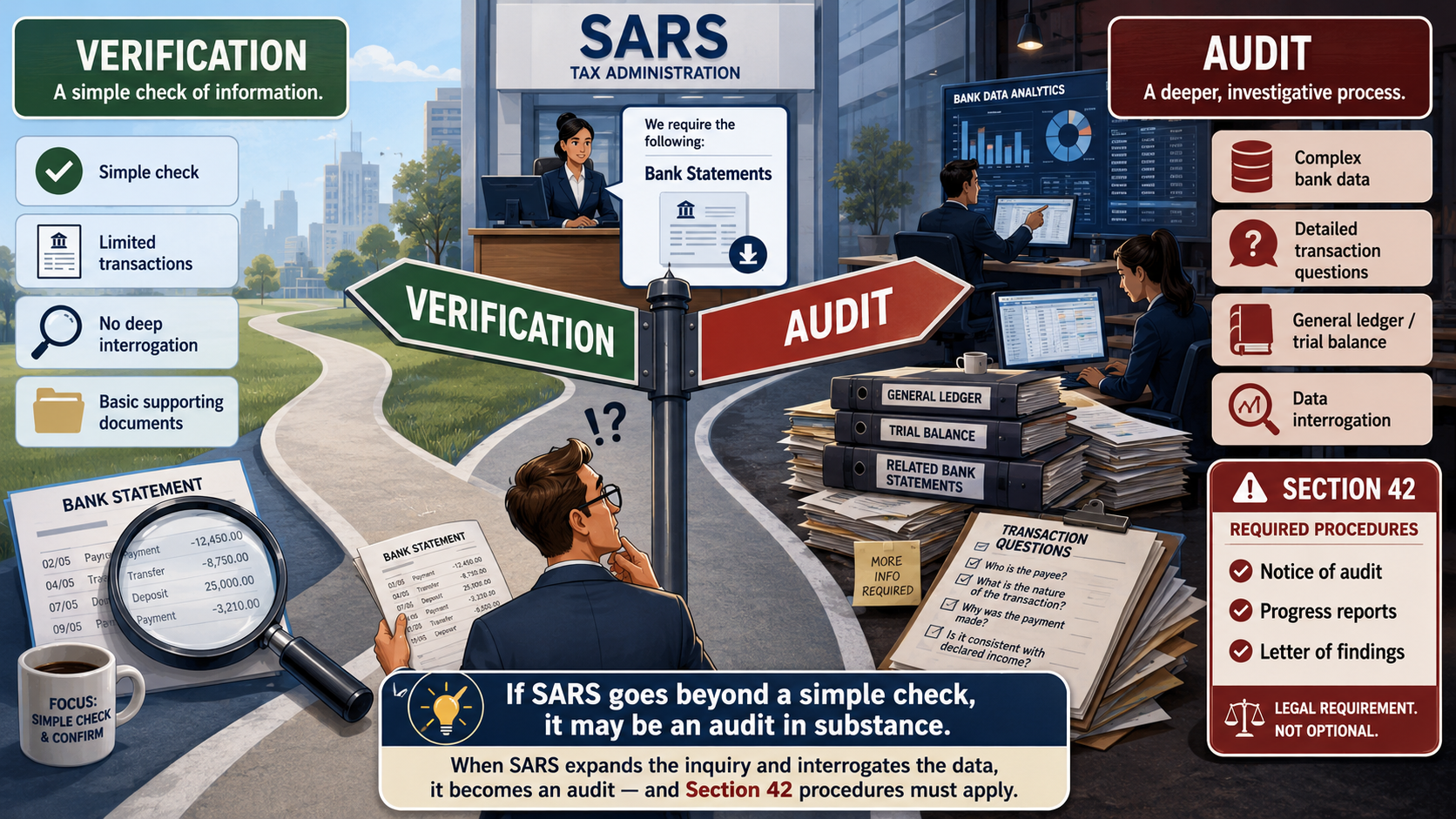
Verification versus audit

The label used by SARS is not decisive. The substance of the process matters.

A verification is a limited check. An audit is a wider examination of the taxpayer's records, accounting treatment and tax position. If SARS requests selected VAT invoices, that may remain a verification. But if SARS requests substantially all records, all vouchers, all bank statements and all supporting documents, the process may have moved into audit territory.

This matters because an audit carries procedural safeguards. SARS should provide proper notice, communicate the basis of the audit, and give the taxpayer a fair opportunity to respond to proposed adjustments. SARS should not avoid those safeguards simply by calling the process a verification.

The section 95(1)(c) warning: notice or threat?

SARS verification letters often include a warning that failure to submit the requested material may result in an estimated assessment under section 95(1)(c).

SARS may say this is merely a statutory warning. In principle, taxpayers should be told the consequences of non-compliance. However, the warning becomes problematic where it is attached to a request that is vague, excessive or impossible to satisfy in the time allowed. In that context, the warning operates as a threat: comply with an unreasonable request or face an estimated assessment.

That is not fair administration. SARS should only rely on section 95(1)(c) where the underlying request was clear, relevant, proportionate and capable of being complied with.

Non-receipt and practical difficulties

Another common problem is that taxpayers do not always receive SARS notices. A request may be placed on eFiling, sent to the wrong profile, missed by the taxpayer, or not brought to the attention of the person responsible for compliance.

Section 95(1)(c) refers to delivery of more than one request. But delivery is not always the same as actual knowledge. Where the taxpayer genuinely did not receive the request, SARS should be slow to impose the severe consequence of an estimated assessment. The real question is whether the taxpayer was given a fair opportunity to comply.

The same applies where the taxpayer receives the request but cannot comply because of the volume of documents, system limitations or the need to obtain records from third parties.

What the taxpayer should do

The taxpayer should not ignore the request.

If the SARS request is unclear, too wide or impossible to comply with in the time allowed, the taxpayer should respond before the deadline. The response should state that the taxpayer is willing to comply, but that SARS must identify the specific issue being verified, narrow the request if necessary, grant an extension, or accept documents in batches.

If SARS has already raised an estimated assessment, the taxpayer should act immediately. The taxpayer should submit the outstanding material and request a reduced or additional assessment under section 95(6). In VAT estimated-assessment cases, this must be done urgently, as SARS refers to a 40-business-day period from the VAT217 notice.

The taxpayer should also consider a suspension of payment request under section 164 where the estimated assessment creates an immediate debt.

Conclusion

SARS may verify. SARS may request relevant material. SARS may estimate in proper cases. But SARS must act fairly.

Relevant material must be relevant to a specific verification purpose. A verification should not become an open-ended demand for everything. If SARS is effectively examining the taxpayer's full accounting records, the process may be an audit, and the audit safeguards should apply.

In VAT cases, SARS should not mechanically reverse input tax for late submission, partial submission or minor invoice defects where the underlying transaction is genuine and can be proved.

The warning of section 95(1)(c) should also not be used as a threat to force compliance with an unreasonable request. Section 95(1)(c) should be used as an estimating mechanism where SARS genuinely cannot assess because relevant material has not been provided. It should not be used as a punitive shortcut where the taxpayer was not given a fair, clear and reasonable opportunity to comply.

SARS requests for documents after prescription: rent apportionment, relevant material and the taxpayer's response

How to respond when SARS asks for documents from a year that has already prescribed — protecting the taxpayer without triggering allegations of non-cooperation.

Introduction

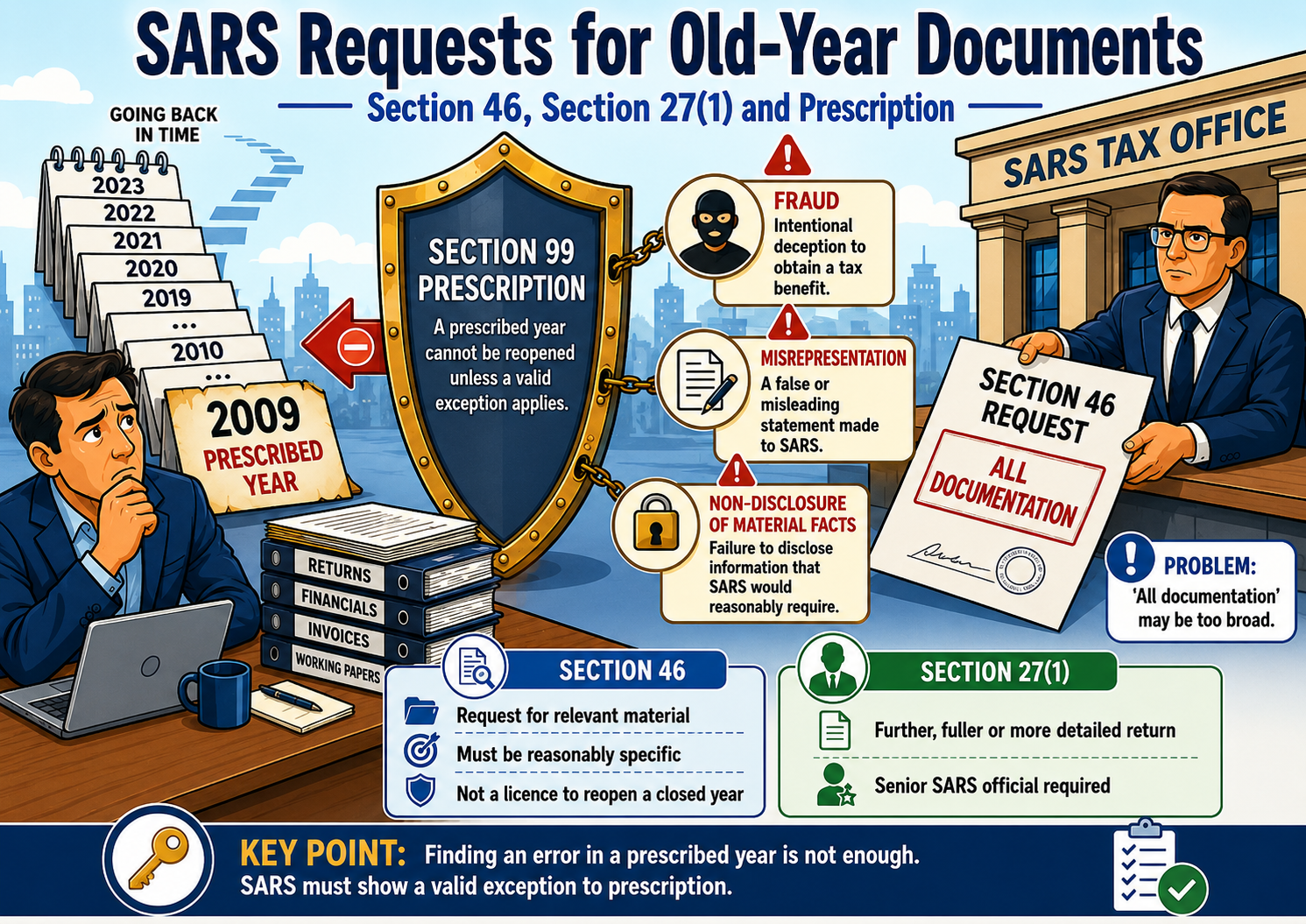
Prescription is one of the most important protections available to taxpayers in the South African tax administration system. It prevents tax affairs from remaining open indefinitely and creates finality once the statutory period has expired. The practical question often arises where SARS, during the verification or audit of a later year, identifies a problem that may also have existed in an earlier year. A common example is rent expenditure that SARS believes should have been apportioned between deductible and non-deductible use. SARS may then request documents for an earlier year that has already prescribed. The taxpayer must then decide how to respond.

The issue is not whether SARS may ever request information. SARS has wide powers to request relevant material. The issue is whether SARS may use a document request after prescription to reopen a year that is already closed. The taxpayer's response must be careful. A flat refusal may create unnecessary risk. Full compliance without reservation may also create risk, because SARS may attempt to use the documents to support an additional assessment. The correct approach is usually a qualified response that records prescription, reserves the taxpayer's rights, and requires SARS to identify the legal basis for requesting documents relating to a prescribed year.

The purpose of prescription

Prescription under section 99 of the Tax Administration Act exists to provide certainty. Once the prescribed period has passed, SARS is generally barred from issuing a further assessment for that year. Section 99 establishes the limitation period for SARS to issue assessments and the default period is three years after the original assessment, subject to specified exceptions.

For most income tax assessments, the ordinary prescription period is three years from the date of the original assessment. For self-assessment taxes, such as VAT and PAYE, the period is generally five years. This distinction is important. In an income tax rent-apportionment matter, the first question is whether SARS is within three years from the date of the original assessment. If SARS is outside that period, SARS must identify an exception before it can raise an additional assessment. For VAT or PAYE matters, the question is usually whether SARS is within five years.

The rent apportionment example

Assume a taxpayer claimed rent expenses in an earlier income tax year. The taxpayer used the premises partly for trade and partly for another purpose, or SARS later forms the view that the rent was not fully deductible. SARS then audits a later year, still within prescription, and discovers that the rent expense in that later year should have been apportioned.

SARS may be entitled to examine and adjust the later year if it is still within prescription. The taxpayer must engage with SARS on the merits of that open year. The taxpayer may have to provide the lease agreement, floor plan, usage schedule, management accounts, general ledger, and calculation of the deductible portion of the rent.

However, the later-year finding does not automatically reopen an earlier prescribed year. SARS cannot simply say: "We found the apportionment was wrong in 2024, therefore we will reopen 2020." Prescription still applies to the earlier year. SARS must show why the earlier year falls within one of the statutory exceptions.

The section 99 exceptions

Section 99(2) is the key provision. Prescription does not apply where the full amount of tax was not assessed due to fraud, misrepresentation, or non-disclosure of material facts. In the case of an assessment by SARS, prescription may be displaced where the failure to assess the full amount was due to fraud, misrepresentation, or non-disclosure of material facts.

For self-assessment, the exceptions are expressed more specifically. They include fraud, intentional or negligent misrepresentation, intentional or negligent non-disclosure of material facts, or failure to submit a return or make the required payment.

The distinction matters. SARS must do more than identify an error. SARS must identify the statutory exception. In a rent case, SARS must show that the non-apportionment was not merely an incorrect tax treatment, but was caused by fraud, misrepresentation, or non-disclosure of material facts.

Error versus non-disclosure

A disagreement about rent apportionment is not automatically non-disclosure. Many tax disputes arise because SARS and the taxpayer disagree on the application of the law to disclosed facts. That is different from the taxpayer hiding facts.

For example, if the taxpayer disclosed rental expenditure in the tax return, financial statements, tax computation, or accounting records, and SARS could have requested supporting documents within the prescription period but failed to do so, the taxpayer has a strong prescription argument. SARS may say the rent should have been apportioned. The taxpayer may say the rent was fully deductible, or that any apportionment adopted was reasonable. That is a merits dispute. It does not automatically become a prescription exception.

Non-disclosure requires a material fact that was not disclosed. In a rent case, a material fact might be that part of the premises was used privately, or by another entity, or for exempt activities, and that this fact was not disclosed or could not be identified from the return or supporting records. Even then, SARS must connect the non-disclosure to the failure to assess the full amount of tax within the ordinary prescription period.

The taxpayer should therefore insist that SARS identify the specific material fact allegedly not disclosed. It is not enough for SARS to state generally that the rent was incorrectly claimed. SARS must explain what was not disclosed, why it was material, and how it caused the under-assessment.

SARS' power to request relevant material

Section 46 of the Tax Administration Act gives SARS power to request relevant material for the purposes of the administration of a tax Act. SARS may require a taxpayer or another person to submit relevant material within a reasonable period.

The same provision requires that the taxpayer submit relevant material at the place, in the format, and within the time specified in the request. It also allows SARS to extend the period if reasonable grounds for an extension are submitted by the taxpayer. Importantly, section 46(6) provides that relevant material required by SARS must be referred to in the request with reasonable specificity.

This means that SARS cannot make an unlimited or vague demand. A request for "all documents relating to rent for the past ten years" may require challenge or clarification. SARS must identify the material required with reasonable specificity. The taxpayer may ask SARS to specify the year, tax type, issue, document category, and relevance.

However, the existence of section 46 does not mean SARS may revive a prescribed year merely by requesting documents. SARS' information-gathering power must be considered together with section 99. Where a year has prescribed, the taxpayer should not ignore SARS, but should require SARS to explain the statutory basis for requesting documents in relation to a closed year.

The danger of a flat refusal

A taxpayer should be cautious before simply refusing to provide documents. A refusal may be used by SARS to allege non-cooperation. It may also escalate the matter unnecessarily. In some cases, SARS may contend that the documents are relevant to an open year, even if they relate historically to a prior year. For example, SARS may request the original lease agreement signed in an earlier year to verify the rent deduction in a later year that is still open. In that case, the document may be relevant to an open year, even though the document was created in a prescribed year.

The correct question is therefore not merely whether the document is old. The correct question is whether SARS is using the document request to administer an open year or to reopen a prescribed year.

A flat refusal may be risky where the document is relevant to an open year. But where SARS expressly requests documents for the purpose of adjusting a prescribed year, the taxpayer should raise prescription immediately.

The better response: qualified engagement

The safest response is usually to engage, but under reservation of rights. The taxpayer should respond within the SARS deadline and say: the year has prescribed; the taxpayer does not waive prescription; the taxpayer does not accept that SARS may reopen the year; SARS must identify the legal basis for the request; SARS must confirm whether it relies on section 99(2); SARS must identify the alleged fraud, misrepresentation, or non-disclosure; SARS must confirm that any documents supplied will not constitute a waiver of prescription; and SARS must confirm that no additional assessment will be issued unless SARS establishes a valid section 99(2) exception.

This approach avoids non-compliance while protecting the taxpayer's legal position.

SARS cannot extend prescription after it has expired

A further important point concerns extensions of prescription. The Commissioner may extend a prescription period by prior notice of at least 30 days to the taxpayer, before the expiry of the period, by a period approximate to a delay arising from the taxpayer's failure to provide relevant material requested under section 46 or from resolving an information entitlement dispute.

The words "before the expiry" are critical. If the year has already prescribed, SARS cannot normally revive it by issuing a fresh document request after expiry and then saying the taxpayer's delay extends prescription. Section 99(3) operates before the prescription period expires. It does not convert an already prescribed year into an open year.

Any agreement to extend prescription must be made before the expiry of the original period. This supports the taxpayer's argument that SARS must act timeously if it wants to preserve its ability to assess.

Where SARS never requested documents during prescription

The taxpayer's position is stronger where SARS never requested documents during the prescription period. SARS had the statutory power to verify, audit, and request relevant material before prescription expired. If SARS did not exercise those powers, it cannot later convert its own inaction into taxpayer non-disclosure.

This is particularly important in the rent apportionment example. If the rent expense was disclosed in the financial statements or tax computation, and SARS never asked for the lease, floor plan, or allocation schedule before prescription expired, the taxpayer can argue that SARS had the opportunity to investigate the issue and did not do so.

The taxpayer should not say only: "SARS never asked." The stronger formulation is: SARS had the right to request documents before prescription; the taxpayer submitted the return; the rent expense was disclosed; no documents were withheld because no request was made; SARS did not extend prescription before expiry; SARS has not identified fraud, misrepresentation, or non-disclosure; therefore, the year remains prescribed.

Later-year findings do not automatically prove earlier-year non-disclosure

SARS may argue that a later-year rent apportionment adjustment reveals a pattern. That may be factually relevant, but it does not by itself override prescription. A later-year finding may cause SARS to suspect that the same issue existed earlier. Suspicion is not enough. SARS still has to identify the section 99(2) exception for the prescribed year.

The taxpayer should separate the years. For the later year that is within prescription, the taxpayer should deal with the merits of the apportionment. For the earlier prescribed year, the taxpayer should raise prescription and require SARS to prove the exception.

This separation is essential. If the taxpayer mixes the two years together, SARS may try to treat the merits of the later year as an admission for the earlier year. The taxpayer should avoid making unnecessary admissions. A concession that apportionment may be appropriate in the later year should not be framed as an admission that the earlier year was incorrectly or dishonestly filed.

Practical wording for the taxpayer's position

A suitable position is:

"The taxpayer records that the year of assessment concerned has prescribed under section 99(1) of the Tax Administration Act. The taxpayer does not waive reliance on prescription. SARS did not request the relevant material during the prescription period and did not issue any notice extending prescription before expiry. The rent expense was disclosed in the taxpayer's return, financial statements, tax computation, or accounting records. There was no fraud, misrepresentation, or non-disclosure of material facts. SARS is requested to identify the specific section 99(2) exception relied upon and the material facts allegedly not disclosed before requiring documents for a prescribed year."

This wording does three things. It responds to SARS. It preserves prescription. It shifts the focus to SARS' burden to identify the exception.

Documents supplied under reservation of rights

Where the taxpayer decides to provide documents, the submission should be expressly qualified. The covering letter should state that the documents are provided under reservation of rights, without waiver of prescription, and only to avoid any allegation of non-cooperation.

The taxpayer should also state that the documents may not be used to contend that the taxpayer agreed to reopen the year. If SARS wants to assess the prescribed year, SARS must first identify a valid statutory exception.

A reservation of rights is not a magic formula, but it is important evidence of the taxpayer's position. It prevents SARS from arguing that the taxpayer voluntarily accepted that the year was open.

Conclusion

Where SARS requests documents for a year that is already out of prescription, especially in relation to rent apportionment, the taxpayer should not ignore SARS and should not issue a reckless refusal. The proper approach is a controlled and qualified response.

Prescription is a substantive protection. SARS generally has three years for income tax and five years for self-assessment taxes. Once that period has expired, SARS must rely on a section 99(2) exception such as fraud, misrepresentation, or non-disclosure of material facts. A disagreement about rent apportionment is not, by itself, proof of any of those exceptions.

SARS may request relevant material under section 46, but the request must be reasonably specific and must be connected to a valid tax administration purpose. If the request concerns a prescribed year, SARS should be asked to identify the statutory basis for the request and whether it relies on section 99(2). If SARS did not request documents before prescription and did not extend prescription before expiry, it cannot usually revive the year by making a late request.

The taxpayer's best position is to respond promptly, reserve all rights, refuse to waive prescription, ask SARS to identify the exception relied upon, and provide documents only where appropriate and strictly under reservation. This approach protects the taxpayer while avoiding the risks that come with outright non-compliance.

The double taxation problem within the lump sum aggregation framework

How the notional re-calculation of prior lump sums using current tables creates a hidden double tax — and the correct way to claim the actual tax already paid.

Introduction

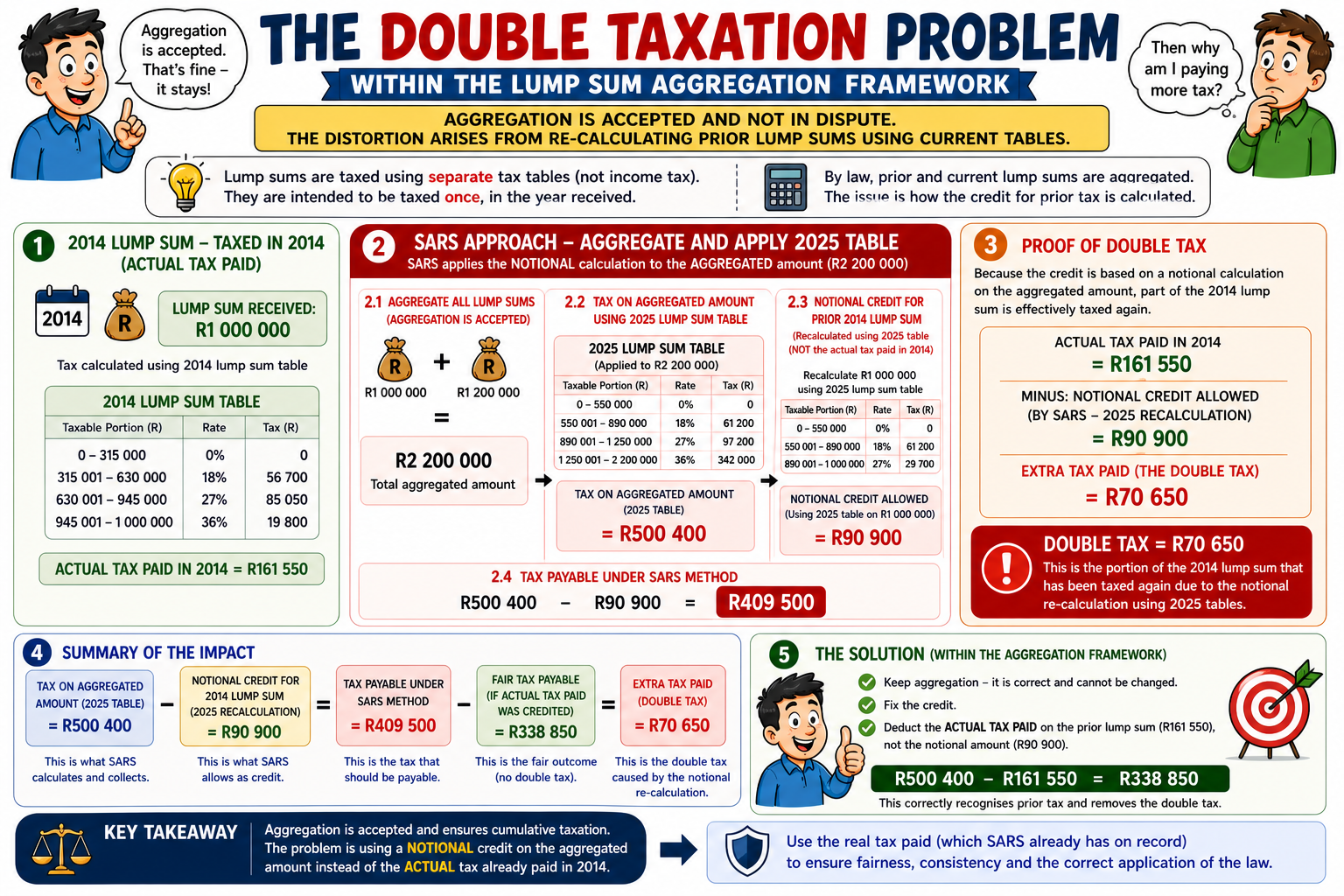
Lump sums are taxed using separate tax tables, not the ordinary income tax tables. They are intended to be taxed once, in the year received. By law, prior and current lump sums are aggregated when a taxpayer receives multiple lump sums over time. The issue is how the credit for prior tax is calculated.

Aggregation itself is accepted and not in dispute. The distortion arises from re-calculating prior lump sums using current tables rather than crediting the actual tax already paid. This creates a hidden double taxation that many taxpayers and practitioners do not immediately recognise.

The 2014 lump sum — taxed in 2014

Consider a taxpayer who received a lump sum of R1 000 000 in 2014. The tax was calculated using the 2014 lump sum table. The actual tax paid in 2014 was R161 550. This is the real tax that SARS collected and that the taxpayer has already paid.

The 2014 table applied progressive rates: 0% on the first R315 000, 18% on the band up to R630 000, 27% on the band up to R945 000, and 36% on the balance up to R1 000 000. The total tax of R161 550 was correct at the time and has been paid.

SARS approach — aggregate and apply the 2025 table

When the taxpayer later receives another lump sum — say R1 200 000 in 2025 — SARS aggregates the two amounts. The total aggregated amount is R2 200 000. SARS then applies the 2025 lump sum table to the aggregated amount. The tax on R2 200 000 under the 2025 table is R500 400.

The problem arises in the credit for the prior 2014 lump sum. SARS recalculates the tax on the 2014 R1 000 000 using the 2025 table, not the 2014 table. This produces a notional credit of R90 900 — substantially less than the R161 550 actually paid in 2014.

The SARS method then calculates tax payable as R500 400 minus the notional credit of R90 900, giving R409 500. But this is not the correct outcome.

Proof of double tax

The double tax becomes clear when the actual tax paid is compared with the notional credit allowed. The actual tax paid in 2014 was R161 550. The notional credit allowed by SARS under the 2025 recalculation is only R90 900. The difference — R70 650 — is the extra tax paid because of the notional re-calculation.

This R70 650 represents the portion of the 2014 lump sum that has been taxed again. It is not a new tax on the 2025 lump sum. It is a second layer of tax on the 2014 lump sum that arises solely because SARS used a current table to recalculate historical tax rather than crediting the tax that was actually paid.

Summary of the impact

The distortion can be summarised in four steps. First, SARS calculates tax on the aggregated amount using the 2025 table: R500 400. Second, SARS allows a notional credit for the 2014 lump sum recalculated using the 2025 table: R90 900. Third, the tax payable under the SARS method is R409 500.

Fourth, and most important, the fair tax payable — if the actual tax paid in 2014 was properly credited — is R338 850. The extra tax paid, the double tax, is R70 650. This is the amount that should not have been charged.

The solution

The correct approach is straightforward. Aggregation must remain because the law requires it and it ensures cumulative taxation. The credit, however, must be fixed. The taxpayer should deduct the actual tax paid on the prior lump sum — R161 550 in this example — not the notional amount of R90 900.

Applying this correction: R500 400 minus R161 550 equals R338 850. This correctly recognises the prior tax already paid and removes the double tax. It ensures fairness, consistency and the correct application of the law.

Key takeaway

Aggregation is accepted and ensures cumulative taxation. The problem is using a notional credit on the aggregated amount instead of the actual tax already paid in the earlier year. SARS already has the real tax paid on record. The taxpayer and practitioner should insist on crediting the actual tax paid to ensure fairness, consistency and the correct application of the law.

When SARS uses AI: why the TAA is not AI-friendly in formal decision-making

SARS is increasingly using automation, data analytics and AI in tax administration. But when the TAA requires a senior SARS official to make a decision, can AI effectively make that decision with a human merely approving it?

Introduction

SARS is increasingly using automation, data analytics and AI in tax administration. That much is clear. But an important legal question arises when the Tax Administration Act (TAA) requires a senior SARS official to make a decision. Can AI effectively make that decision, with a human merely approving it? In my view, that is where the problem begins.

The TAA is not anti-technology, but it is not AI-native legislation. It is drafted around identifiable human functionaries, written authority, designated posts and clear lines of accountability. The Act contemplates decisions being made by the Commissioner, a senior SARS official, or another SARS official with proper authority. That structure is built for human decision-making, not for a machine to become the real decision-maker behind the outcome.

This distinction is critical. There is nothing inherently unlawful about SARS using AI to assist with administration. AI may help with case selection, risk profiling, anomaly detection, data matching and even pre-population of returns. But assistance is one thing; substitution is another. If AI becomes the substantive decision-maker, and the official merely rubber-stamps the result, the decision becomes legally vulnerable.

The Constitution strengthens this point

The Constitution strengthens this point. Section 33 requires administrative action to be lawful, reasonable and procedurally fair, and it gives a right to written reasons. Section 195 requires public administration to be accountable, transparent and fair. Those principles require more than a name at the bottom of a notice. They require that the lawful decision-maker actually apply an independent mind to the taxpayer's facts.

PAJA takes the matter further

PAJA takes the matter further. Administrative action may be reviewed if the decision-maker was not authorised, if there was no proper procedure, if the process was unfair, if relevant facts were ignored, if the decision was arbitrary or irrational, or if adequate reasons were not given. Those review grounds fit squarely into the AI debate. A machine-driven outcome, adopted without real human evaluation, may amount to no proper application of mind at all.

POPIA also matters

POPIA also matters. Section 71 places limits on decisions with legal or substantial effects where they are based solely on automated processing intended to profile a person. That provision reinforces the broader concern that fully automated adverse decisions sit uneasily with South African administrative law.

Warning signs for practitioners

For practitioners, the warning signs are practical. Does the SARS decision engage properly with the taxpayer's actual facts? Does it explain why submissions were rejected? Or does it read like a generic, formulaic response? If the reasons are standardised and disconnected from the case, one must ask whether there was a real human decision at all.

The better argument

The better argument is therefore not that SARS may never use AI. It is that the TAA allows AI support, but it is not AI-friendly where Parliament requires a human official to decide. The issue is not modernisation. The issue is legality. Where the law says a senior SARS official must decide, the final judgment must remain human, accountable and properly reasoned.

The bottom line

The bottom line is simple: AI may help SARS administer, but it cannot lawfully replace the human decision-maker where the TAA requires human authority.

When SARS Overreaches: Why Practitioners Must Separate the Adjustment from the Penalty

SARS letters often move quickly from a disputed adjustment to a behavioural finding and then to a severe understatement penalty. Practitioners must resist that leap.

Introduction

Tax practitioners have become accustomed to strong language in SARS correspondence. Audits are framed robustly, findings are often expressed confidently, and letters sometimes carry an unmistakable tone of finality even where important facts remain disputed. That is not, by itself, the problem. SARS is entitled to audit, to question return positions, and to raise additional assessments where it believes the fiscus has been prejudiced. The real problem begins when SARS moves too quickly from a disputed adjustment to a behavioural finding, and from that behavioural finding to a severe understatement penalty.

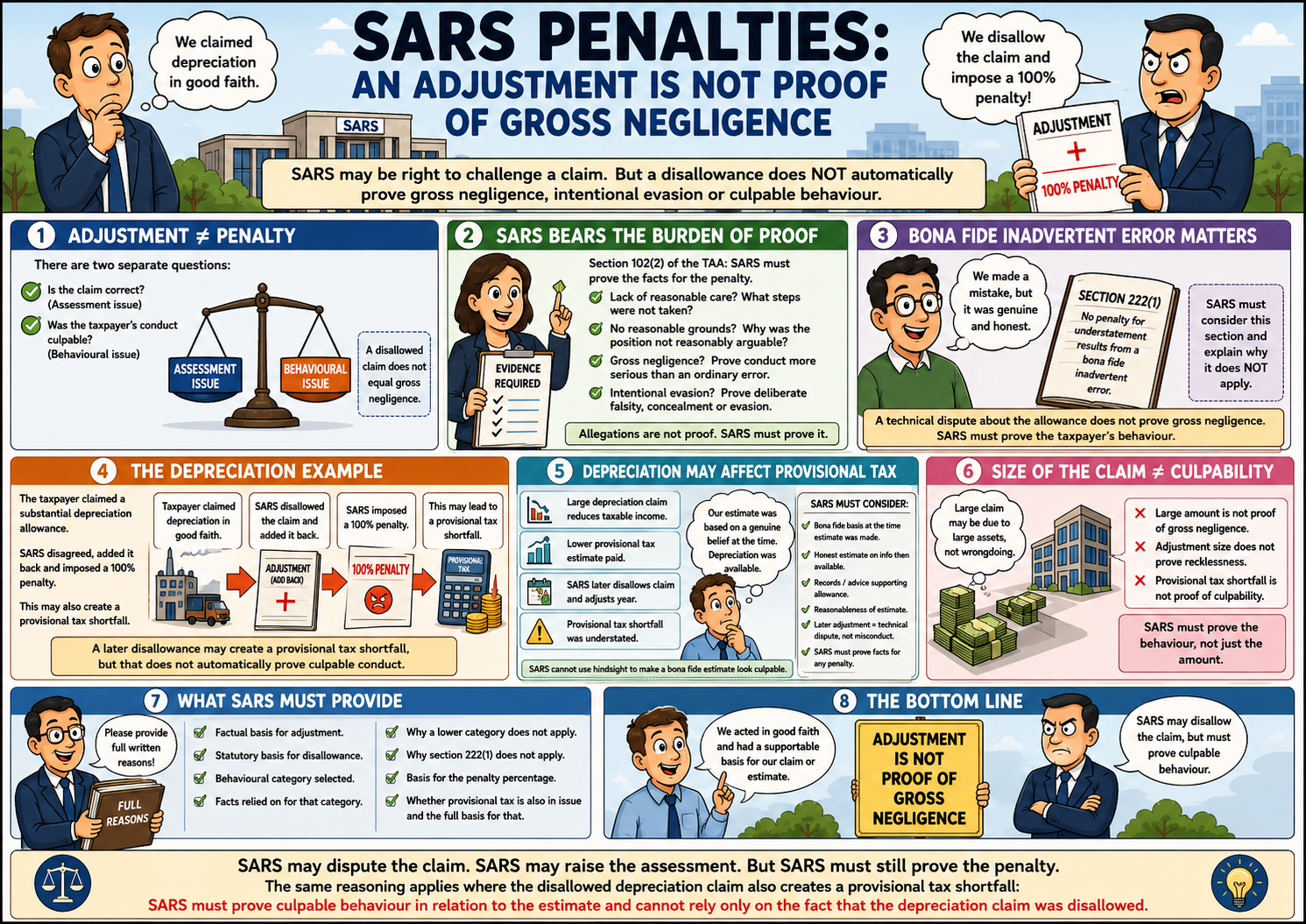
That pattern deserves careful attention because it can distort the dispute process. A deduction may be disallowed. An allowance may be recalculated. A VAT figure may be reconstructed. But none of those outcomes automatically means the taxpayer acted negligently, grossly negligently, or intentionally. Those are separate enquiries and should always be treated as such.

The distinction is well illustrated by two recent types of SARS correspondence. In one corporate income tax audit findings letter, SARS proposed finance cost and depreciation adjustments for the 2023 and 2024 years of assessment and then proposed understatement penalties of 100% for gross negligence and, in relation to one depreciation item, 150% for alleged intentional tax evasion. In a separate VAT finalisation letter, SARS reconstructed output tax from bank deposits, revised its view after receiving further explanations and loan-account material, but still imposed a 25% understatement penalty on the basis of "reasonable care not taken". Together, those letters show how SARS overreach can develop in practice.

The first mistake practitioners must avoid

One of the easiest traps in practice is to accept SARS's structure of argument. SARS will often present matters in a sequence that feels natural: the return was wrong, therefore there was an understatement, therefore a penalty follows, therefore the behaviour fits into a serious category. If the practitioner accepts that structure without breaking it apart, the case becomes far harder to defend.

The correct approach is to separate every issue.

The first question is whether the tax treatment was in fact wrong. The second is whether SARS has properly explained why it says the treatment was wrong. The third is whether the factual material relied upon by SARS is complete and properly particularised. Only then should one ask whether the conduct was blameworthy, and if so at what level. In other words, the tax issue and the penalty issue are related, but they are not the same.

This distinction is essential because SARS sometimes writes as if an adjustment is already proof of culpability. That is simply not so. A tax adjustment is about the correct tax outcome. An understatement penalty is about the taxpayer's behaviour. Those are different legal and practical enquiries, and practitioners should resist any attempt to merge them into one.

A good example of overreach: documentation disputes turned into behavioural findings

The corporate income tax audit findings letter provides a useful illustration. SARS proposed disallowing finance costs and depreciation, recording total proposed adjustments of more than R10 million. In relation to depreciation, SARS stated that only limited invoices had been provided and that depreciation would be allowed only to the extent supported by the asset register and invoices. It then linked that dispute to a penalty narrative based on gross negligence.

This is a familiar move. A documentation problem becomes a tax problem, and then, almost immediately, a behavioural problem.

But incomplete documentation does not automatically prove culpable conduct. It may weaken the taxpayer's evidential position, but that is not the same thing as proving that the taxpayer acted with serious fault. In practice, the existence, ownership and use of an asset may often be supported by more than just one class of document. Asset registers, finance agreements, bank records, insurance schedules, registration documents, maintenance records and internal working papers may all become relevant. SARS is entitled to test the evidence, but it is not entitled to assume that any documentary gap automatically converts the matter into gross negligence.

That is a practical lesson practitioners should remember: weak proof is not the same thing as bad faith. SARS often compresses those ideas together, and advisers need to unpack them again.

The danger of treating absence of receipts as proof of no trade

The most striking feature of the income tax letter is SARS's treatment of the 2024 depreciation claim. SARS stated that there was no trading during the year of assessment and that bank statements reflected no business receipts. On that basis, it concluded that depreciation had to be disallowed because the assets were not used in the production of income. It then went much further and proposed a 150% understatement penalty on the basis of alleged intentional tax evasion.

This is precisely the kind of analytical leap practitioners should challenge.

A year with no business receipts does not always mean there was no trade in the relevant tax sense. Businesses may experience temporary inactivity. Assets may be held ready for use. Vehicles may be under repair, off the road for regulatory reasons, standing idle in a weak market, or retained as part of a business structure awaiting contracts. The absence of visible revenue may be relevant, but it is not self-proving. Much depends on the broader factual context.

Even more importantly, the step from "no receipts" to "intentional tax evasion" is simply too large unless SARS can point to proper facts supporting intention. Intentional tax evasion is an extremely serious allegation. One would ordinarily expect concealment, falsification, fabricated records, knowingly false statements, or some similar conduct demonstrating conscious evasion. Yet the letter, as framed, moves from a dispute about depreciation to a conclusion of intent without setting out the sort of factual foundation that such a conclusion would ordinarily require.

Practitioners should therefore be alert to a crucial point: a wrong allowance, even if it is wrong, is not automatically tax evasion. SARS must prove intention separately. A disputed deduction and a moral accusation are not the same thing.

Estimated assessments and behavioural conclusions

The VAT finalisation letter illustrates a different but equally important form of overreach. SARS explained that it reviewed the annual financial statements and the vendor's bank statements, identified deposits over the audit period, later removed some deposits after the vendor explained that they were intercompany flows, and then retained four deposits as taxable supplies. On that basis, SARS finalised an output tax adjustment and imposed a 25% understatement penalty for reasonable care not taken.

This raises a different set of concerns.

Where SARS reconstructs VAT from bank deposits, it is working by inference. A bank deposit is not automatically output tax. It may be a loan, a capital movement, an intercompany transfer, a non-taxable receipt, or the proceeds of a transaction whose VAT character still needs to be examined properly. In the letter itself, SARS acknowledged that some of its initial assumptions had to be revised once the vendor provided a further explanation and loan-account support. That is important because it shows that the reconstructed position was not self-evident from the start.

Practitioners should use that fact carefully. If SARS's own view changed once fuller information was supplied, that is a strong indication that the matter was fact-sensitive rather than obvious. It becomes much harder, in those circumstances, to treat the reconstructed liability as automatic proof that the vendor failed to take reasonable care. Estimation may justify further enquiry or even adjustment, but estimation is not the same as behavioural proof.

That point matters well beyond VAT. Whenever SARS is working from approximation, inference, or reconstruction, advisers should be cautious about allowing those techniques to become the basis for strong behavioural language.

What practitioners should do when SARS overreaches

The best response is not outrage. It is discipline.

When a SARS letter shows signs of overreach, practitioners should structure their response in layers. First, identify exactly what SARS is alleging. Secondly, test whether SARS has actually proved the facts it relies on. Has it identified the precise assets, entries, invoices, deposits or schedules in dispute? Has it explained its calculations? Thirdly, test whether the legal conclusion really follows from those facts. Fourthly, and separately, deal with behaviour. Even if the adjustment survives in whole or in part, why does that not justify gross negligence, reasonable care not taken, or intentional tax evasion?

This last stage is where many cases are won or lost. Practitioners often spend all their energy on the underlying tax position and leave the penalty issue underdeveloped. That is a mistake. Even where a taxpayer does not succeed entirely on the merits, it may still succeed on penalty. In many matters, that can make a very substantial difference to the eventual outcome.

The wider lesson for the profession

The broader lesson is straightforward. SARS letters must be read critically, not reverently. Strong wording is not the same as strong reasoning. A formal conclusion is not always a fully demonstrated conclusion. The letters discussed here show how easily SARS can move from adjustment to behaviour, and from behaviour to severe penalty language, even where the factual foundation is thinner than the tone suggests.

Practitioners therefore need to hold on to one central discipline: do not let SARS turn every tax disagreement into a moral accusation.

Mistakes happen. Misallocations happen. Documentation gaps happen. Estimated reconstructions happen. None of those situations automatically proves blameworthy conduct. If advisers consistently separate the adjustment from the penalty, and the penalty from the behavioural category, they will often find that SARS's most aggressive conclusions are much weaker than they first appear.